Why does everything we do feel meaningless?
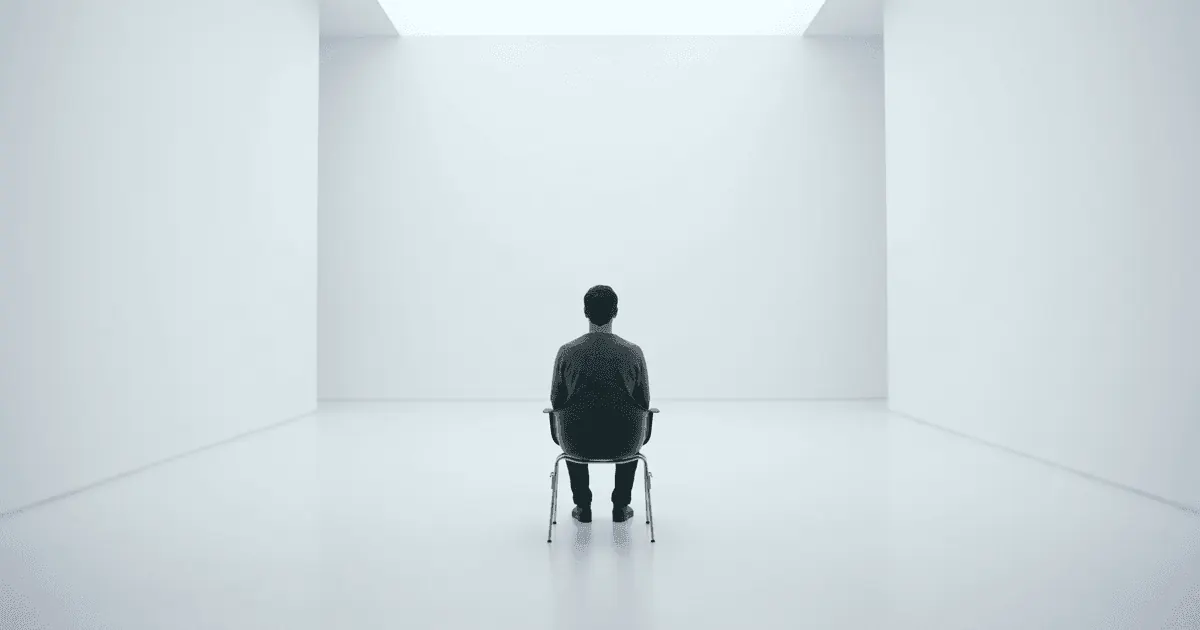
At some point in adult life, almost everyone runs into the same quiet, nagging feeling: you work hard, you commit, you study, you try to improve… and it still all feels a bit empty. As if nothing had much real value. Progress never seems to be enough to quench the thirst of someone who keeps running.
When nothing feels meaningful, the problem is almost always in the way your mind measures progress, not in your life itself. The brain gets used to every achievement quickly, an effect called hedonic adaptation, and it also compares your path with other people’s best moments. With that ruler, any progress looks small.
The automatic, common reaction is to blame yourself: “I guess I lost my discipline.” “Maybe I’m not as capable as I thought.” “It looks like everyone is moving forward, building empires, except me.”
But the truth is that this feeling has almost nothing to do with the facts. It’s just a reading error, the way our mind is interpreting progress in the modern world.
A hardware problem: why the brain got lost
Interpreting reality starts in our mind, but the human brain wasn’t built to record facts in a cold, neutral way. It’s a survival machine that evolved to interpret quick stimuli, create mental shortcuts, fill in gaps and build stories to keep us safe.
And today, the big problem is that we live in a hyperconnected environment with a brain that still runs on the same settings it had thousands of years ago. It’s like trying to run a modern, heavy, graphics-packed program on an old computer. That’s why the reading gets weird, and it’s also a hint about how to fix the problem.
When we’re tired, overloaded or overstimulated, this interpretation fails even more. Not for lack of intelligence or ability, but because of excess. We live surrounded by information, mass opinions, vanity metrics and constant comparison. The more useless stimulus comes in, the less clarity is left. Without clarity, everything seems to lose its meaning.
Why do achievements lose their shine so fast? The trap of hedonic adaptation
To make things worse, there’s a quiet psychological mechanism called hedonic adaptation. It’s our mind’s tendency to quickly return to a stable level of happiness, no matter how much the good things around us change.
As soon as you reach an important goal, buy something you wanted or improve your life, your brain quickly gets used to this new normal and resets the satisfaction bar to zero. What once felt like a big achievement now becomes the basic floor. That explains why progress never feels like enough: the finish line keeps moving forward.
This should take a huge weight off your shoulders. It’s not that you lost your motivation or that your effort is worthless. It’s just human biology pushing you toward the next pursuit, often leaving us exhausted on the treadmill of chronic dissatisfaction.
The burnout society and the rush for results
This endless search for outside validation speaks directly to what philosopher Byung-Chul Han calls “the burnout society.” We have become, at the same time, our own executioners and our own victims. We believe that if we produce more, if we run faster, we’ll reach fulfillment.
“The coincidence of freedom and exploitation creates enormous efficiency and the feeling of greater freedom. But in reality, the person exploits themselves voluntarily and intensely, and ends up perishing because of it.” (Byung-Chul Han, paraphrased)
However, too much positivity and constant pressure to perform make us sick on the inside. The thinker Seneca already warned about how we waste our lives looking at other people’s clocks and forgetting our own time.
Your brain was trained to believe what it sees, almost always without filters. And when it dives into this ocean of edited lives, it completely loses the ability to measure your real progress. The feeling of being stuck rarely comes from standing still; it shows up when we use the wrong references to measure our own journey:
- Constant social comparison with people who are in a different chapter of their story.
- External measures of success that don’t match your values.
- The search for fleeting digital validation.
- A senseless rush for visible short-term results.
- A lack of clear personal, internal criteria.
The core problem isn’t the hunger to grow. The problem is trying to measure that growth with rulers that were never made for your size.
Ending the illusion of perspective
Think of it this way: every human being walks a different road, with unique tools and baggage. The big perception error happens because you live your own behind-the-scenes, with all the doubts, bad days, boredom and wrong turns, but you only watch other people’s edited stage.
On social media, nobody posts the Monday morning doubt, the exhausting trial and error or the moments of creative boredom. We only post the clean result, the final cut, the isolated win.
The primitive brain doesn’t understand this as a constructed, promotional story. It reads it as raw reality. And that’s exactly where the painful feeling of falling behind is born. In short: social media is just the promotional trailer; your real life is the full movie.
How do you find meaning in what you do again? Change your ruler
If the problem is the ruler, the solution is to change your measuring tool. Climbing a mountain in thick fog is the perfect setting for frustration. If you only try to look at the top, hidden in the clouds, you’ll clearly feel like you haven’t moved. But if you look down, at your own feet, at the solid ground you just conquered and at the path behind you, you’ll see how far you’ve already come.
To get back the meaning and control of your journey, make three daily adjustments:
- Swap other people’s metrics for internal criteria: Instead of looking at what others have achieved, ask yourself: “Was I a little more disciplined than yesterday?”, “Am I protecting my focus?”, “Did I learn something useful?”.
- Judge the process, not the trophy: The final result depends on variables you don’t control. The daily building process, you do. Put your energy where you have the power to act.
- Cut the information noise: Set clear limits on how much of other people’s filtered lives you consume. Less of other people’s stage means more clarity for your own mind.
At the end of the day, the most important question you can ask yourself every day isn’t “how many goals did I check off today?”, but: “Who are you becoming in the process?”
Life isn’t a hundred-meter dash against everyone on the track, it’s a long journey of building who you are.
To make sense of this feeling that will pass (we’re rooting for you), here are a few more reads:
- Maybe it’s just poor-quality sleep, so learn more about sleep here.
- That feeling of not getting anywhere has a hidden upside, and it might be a sign that you’re actually moving.
- Sometimes the emptiness comes from living on quick rewards. Here’s the trap that keeps us scrolling.
Editor’s note: You know that friend who always feels stuck, even though they run around all day? Send them this article. Maybe it’s time for them to realize the problem isn’t how fast they’re progressing, but the imaginary, unreachable ruler they decided to measure themselves with.
Comments
No comments yet. Why not be the first?